Close the group without the spreadsheet.
Roll every entity into one set of group numbers the moment you press go — currency, intercompany and minority interest already handled. The heroic spreadsheet retires.
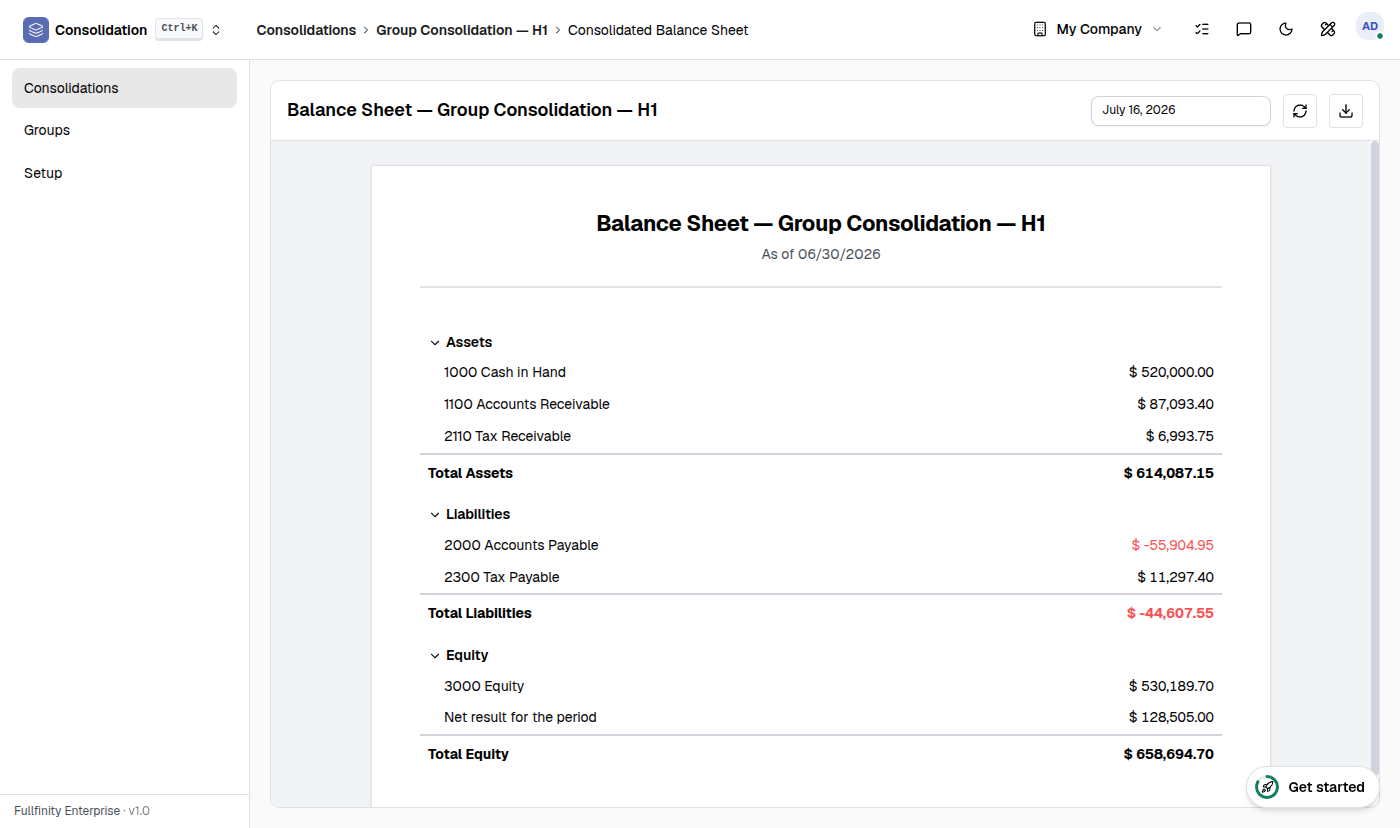

Five entities. Three currencies. One heroic spreadsheet.
Every quarter you export each company’s trial balance, translate it by hand, chase the intercompany balances that never quite agree, and pray the totals tie. It works — until one broken formula quietly hands the board a group balance sheet that doesn’t.
Every entity already lives in one place.
Each subsidiary keeps its own books, in its own currency, in the same system. So the group close isn’t a gathering exercise — it’s pressing compute and reading the result. Translation, eliminations and the minority carve-out all happen in the one step.
Different currencies, one bottom line.
Each entity translates at the right rate — closing for the balance sheet, average for the income statement — and the drift those mixed rates create is captured as a translation adjustment, sitting in equity where it belongs instead of quietly unbalancing the group.
Intercompany washes out on its own.
A loan between two of your own entities is real to each of them and meaningless to the group. Tag the counterpart entity once and every intercompany balance reverses automatically — and anything that doesn’t match, from rate timing to a missed entry, is flagged for you instead of buried in the total.
One connected system
The same customers, products and stock run through Consolidation and every other app — nothing kept in a separate tool.
Open-core
The core apps are open source, and the whole thing is yours to self-host.
Free, unlimited users
Self-host the Free edition with your whole team on it — no per-seat fees, no seat counting, no trial running out.
Only what you need
Run Consolidation on its own, and switch on the rest of the suite when you're ready.
Financial consolidation software, answered.
How is this different from consolidating in a spreadsheet?+
A spreadsheet pulls a snapshot of numbers that are stale the moment you export them, and every translation and elimination is a formula waiting to break. Here each entity’s ledger already lives in the same system — you compute the group and get a stored, drill-through worksheet you can re-run any time and get the same figures.
Does it handle foreign-currency subsidiaries?+
Yes. Each entity is translated by the current-rate method — closing rate for assets and liabilities, average for income and expense, historical for equity — and the drift those mixed rates create is captured as a cumulative translation adjustment (CTA), not lost. Every rate it used is shown and can be overridden before the run is locked.
Can it consolidate partly-owned entities and associates?+
Yes. Set an ownership percentage and a method per entity: Full brings it in line-by-line and carves out the minority as non-controlling interest, Proportional scales every balance by ownership, and Equity brings an associate in as a single share-of-profit pickup. One group can hold all three.
Can I still make manual group adjustments?+
Yes. Top-side adjustments — reclassifications, fair-value uplifts, goodwill, or an elimination the detector can’t infer — are booked directly at the group level as balanced entries and land on the same worksheet, so nothing sits outside the numbers.
Which plans include Consolidation?+
Consolidation is part of the Standard and Enterprise plans and sits on top of Accounting — each entity keeps its own books in Fullfinity, and the group rolls up from there.
Apps that pair with Consolidation
Run Consolidation — and the rest of your business — in one place.
Join the waitlist and be first through the door when Fullfinity launches.
Join the waitlist